More complicated words and acronyms for you, this time Trigger Point Therapy or as therapists like to say, ‘Take a deep breath in and relax’ (because you know what is coming).
Trigger Point release is uncomfortable but is normally the root of many of our problems and for that short period of discomfort they normally solve a myriad of issues.
So, what are Trigger Points?
“A highly irritable band, localised point of exquisite tenderness, in a nodule, in a palpable section of skeletal muscle” Travel & Simms 1993.
Any wiser?
Trying to simplify it, when your muscles contract or lengthen the muscle fibres run smoothly over each other, however, when they get overworked or suffer a trauma these fibres stick together preventing the smooth sliding motion and minor damage can occur. During the repair process Calcium ions not used can build up and become ‘energetic hot spots’ – leading to Trigger Points.
Maybe at some point I will introduce more complicated diagrams and terminology but at this point all you need to know is we are trying to find these Trigger Points to release them and open up the pathways to allow the body to start functioning properly again.
So, what am I looking for as a therapist?
Trigger Points can be found all over the body but as a rule we are trained to start with the Big 7
- Sternocleidomastoid (SCM)
- Trapezius
- Pectoralis Major
- Latissimus Dorsi
- Tensor Fascia Latae (TFL)
- Gluteus Medius
- Adductor Longus
The below diagram is a rough indication of where they are on the body but will be happy to show you next time you visit.
Each one of these areas gives rise to different conditions and normally give a starting point for the therapist to follow a path. It is not always straightforward for a therapist to find the ‘nodule’ but feedback from the client normally helps identify if the right spot has been found and it is always useful for dialogue between the therapist and client to get to the bottom of the issue.
I know some of you have experienced me working on Trigger Points in the past and it can be an experience, but it will help, and it is normally only a short moment of discomfort for long term benefits.
So, if you are experiencing toothache, headache, earache, neck pain, migraines, shoulder issues, thumb pain, finger pain, circulatory issues, golfers’ elbow, tennis elbow, ITB syndrome, knee issues, ankle pain, lower back or a whole range of issues Trigger Point Therapy could be the first port of call to alleviate the discomfort.
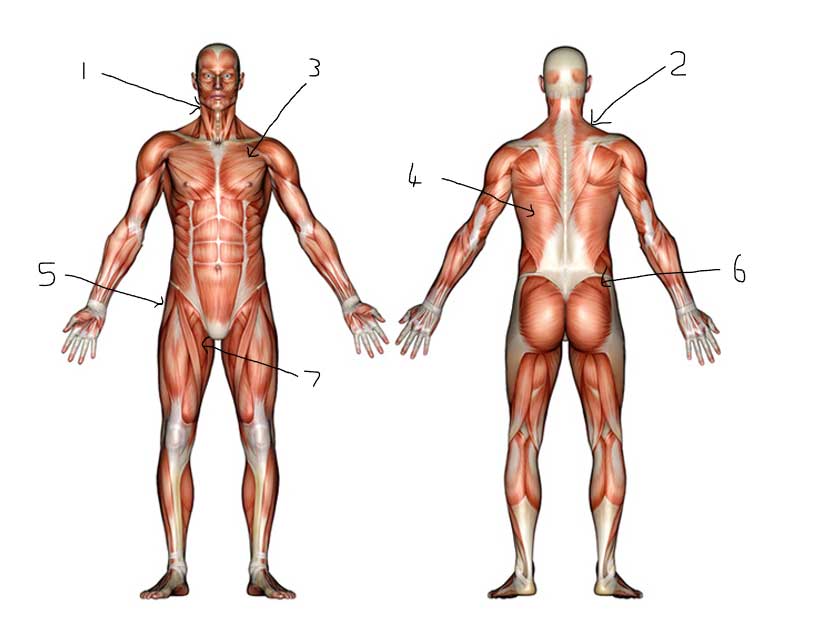
The Big Seven!
1 Sternocleidomastoid (SCM)
2 Trapezius
3 Pectoralis Major
4 Latissimus Dorsi
5 Tensor Fascia Latae (TFL)
6 Gluteus Medius
7 Adductor Longus