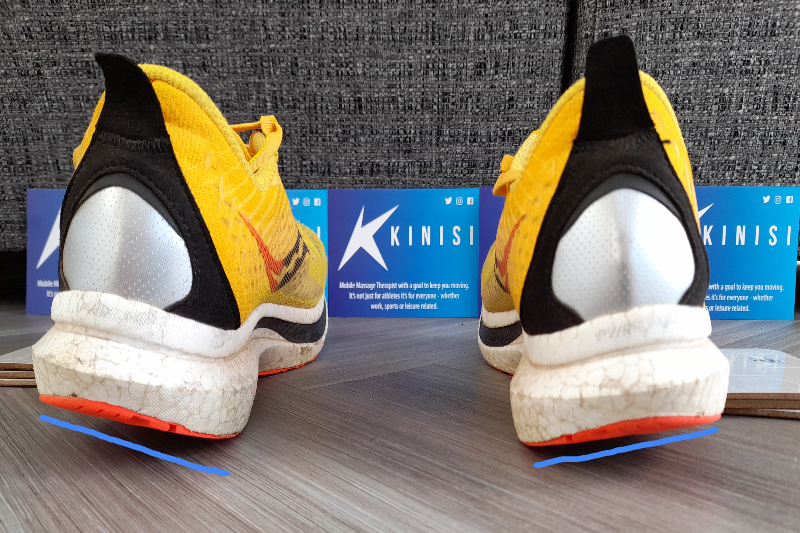
The main method used to analyse gait is visually, by getting the client to walk/run up and down or on a treadmill for example whilst the therapist looks at different points on the body. By looking to see even distribution of weight and balance when walking and not one side favouring the other.
As the foot contacts the ground we look to see how the heel strikes and the foot and toes pronate or supinate, the positioning of the legs, the movement of the pelvis as the body transitions through the different phases of the stride. Looking at the shoulder movements on arm swing, the rotation of the spine, hip extension, knee and ankle movements.
Trying to take all this information in and analyse during a few movements up and down will obviously be very difficult, you will also need to ensure it is done from anterior (front), posterior (rear) and also side views to get a full picture.
So purely visual examination with just the eye will have its drawbacks, there is no permanent record kept and the eye cannot record everything happening at the same time (the skill of the observer is also key), you can also see the motion but not the force of the impact of the heel strike for example.
To assist with the visual analysis, it would help to record the gait, this way there is a more permanent record, but it can also be sped up, slowed down, paused and examined a lot more thoroughly at the therapists ease. It can be played back to the client to show the variations in gait and also improvements made over time due to the treatment plan or exercise program.
I have had my gait analysed at a running shop – what now?
Gait analysis done in a lot of running shops selling footwear is primarily looking for one of the three below results – how your foot strikes the treadmill. Is your weight going through the inside, outside or centre of the trainers (you can also tell this by looking at the wear on the sole or the inside of the trainers) – depending on this will depend on which style of trainer is recommended.
This is a great first step in trying to correct any issues with your foot landing whilst out walking or running and hopefully preventing any issues built up from incorrect foot placement.


Supination Neutral Pronation
(weight towards outside) (even weight) (weight towards inside)
However, as I said earlier, everyone is different – not everyone has or needs the perfect running style ‘but i always wear shoes with support, oh and I always have this little niggle with my knee’.
You have to look at the bigger picture, if the footwear is comfortable and you never have any real injury issues then perhaps you don’t need to change anything. But if you swap and change from one brand or style to another and none of them ever seem to help then perhaps it is not the trainers that need to be changed?
Basically, gait analysis in shops is not necessarily the answer but perhaps a ‘starting’ point
Feel free to talk to me about gait and gait analysis and we can discuss any steps if required, whether it is massage treatment, exercise therapy or other interventions needed.
Don’t forget you can get in touch via Facebook, Instagram or the Website.
Thanks for reading
Paul
NB: For those of you who know me, I am a runner and from experience have had limited running injuries, (normally stupid injuries caused by competing with my teenage sons….I am not 20 anymore!!) and can swap and change from neutral trainers of any brand without them ever causing me any distress.
However, when buying my latest trainers I had a gait analysis done knowing full well that my left hip was tight (from aforementioned stupid bicycle kick attempt during beach football), when analysing the video footage we could see my left side wasnt coming through smoothly. The person looking at the video could see this issue and brought it to my attention – fortunately, they know me and what I do so it didn’t affect my choice of trainers and I knew I had to go and do some stretching and strengthening to sort the issue. (I will try and attach the video – look at it in slow motion if you can and see the left foot doesn’t pick up as straight as the right foot)