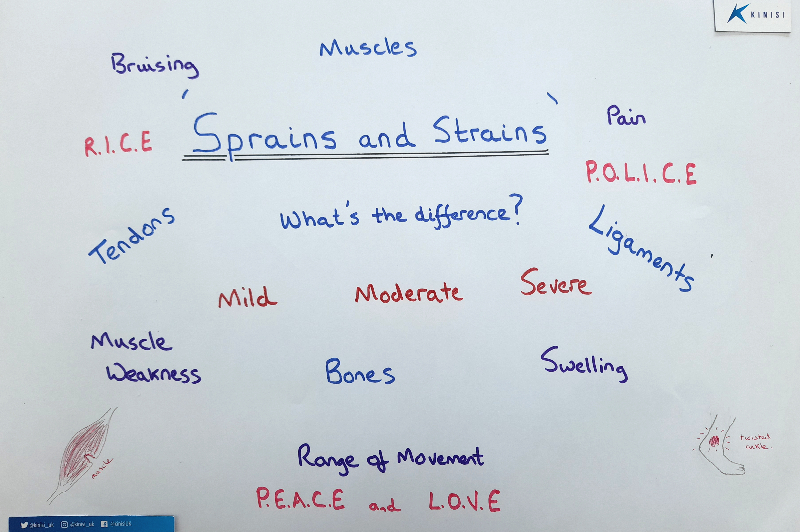
‘Ow! I’ve sprained my ankle’ or ‘Argh! I’ve strained my neck’ might be just two of the phrases you may have uttered over the years but what exactly is the difference between a strain and a sprain and how bad is my injury?
Hopefully over the next 42 pages I will give you a brief breakdown of the difference and the similarities between the two ‘injuries’.
Firstly, some definitions:-
- Ligament – a tough, flexible fibrous tissue that connects bones together to support a joint.
- Muscle – a band or bundle of fibrous tissue that contracts to create movement or maintain position in a human body.
- Tendon – a strong, flexible band of fibrous tissue that attaches muscle to bone.
- Bone – hard whitish tissue that makes up the skeleton.
(For the purpose of this blog we can ignore bone – if you injure a bone it is normally referred to as a fracture not a sprain or a strain and I will be honest it is unlikely sports massage or sports therapy will help in the early stages of a bone injury – maybe during the rehabilitation stage but not straight from A & E.)
Ligaments
Ok, so we can see that the ligaments, muscles and tendons are all made up of fibrous tissue and have slightly varying roles within the body but the main difference is that ligaments attach bones to bones.
Examples:
The cruciate ligaments found in the knee attach the femur (thigh bone) to the tibia (shin bone) – acronyms such as ACL (anterior cruciate ligament), PCL (posterior cruciate ligament).
The ankle ligaments such as the ATFL (Anterior Talo-Fibular Ligament) attach the Fibula (bone on the outside of the lower leg) to the Talus (the ankle bone).
Ligaments are very important for the stability and the strength of a joint and when we damage a ligament it is called….a Sprain.
So to clarify – a Sprain is damage to a ligament.
Muscle and Tendons
As opposed to a ligament, a tendon runs from the end of a muscle and attaches to a bone, if we take the most famous tendon named after the mythological greek warrior ‘Achilles’ – this is formed from the two calf muscles (the gastrocnemius and soleus) and then runs down the back of the ankle and inserts onto the heel bone (calcaneus).
Muscles will normally have tendons at either end that insert into the bone and usually span a joint or in some cases two. The Biceps brachii, found in your upper arm spans both the elbow and the shoulder joint whereas the gluteal muscles (found in your bottom) are only associated with your hip joint.
When we damage the fibres in a muscle or a tendon it is called a strain.
So to clarify – a Strain is damage to a muscle or tendon!
Grades of Strains and Sprains
Now we know which is which it is probably worth spending a few hours discussing the various levels of sprains and strains.
Now, everyone is slightly different so each injury may vary slightly with its symptoms, some people bruise easier than others, people’s perception of pain can be massively different but the general overview is that sprains and strains fall into 3 categories.
Mild – Moderate – Severe
- Mild (or Primary) – would normally be stretched or very minimal if any tearing of the fibres, Potentially mild bruising and swelling, some discomfort and slight restrictions in the movement of the injured body part.
- Moderate (or Secondary) – very likely to be a tear in the fibres, quite an extensive tear with obvious signs of bruising and swelling. There could be quite a lot of pain and the range of movement may have some limitations.
- Severe (or Tertiary) – this is usually a complete rupture or tear of the fibre and will be accompanied by lots of bruising and swelling, the likelihood of a lot of pain and discomfort and possibly complete loss of movement and unable to bear any weight on the injury.
This is quite generic as there will be variation in the diagnosis, what someone may see as a mild tear may be viewed as a moderate tear by someone else – it is important to listen to the client, they know their body better than anyone.
Overview
So we know the difference between a sprain and a strain and whether it is mild, moderate or severe but how did it happen? What can we do about it? What are the main concerns?.
Generally, sprains are the result of a trauma, a collision between footballers, runners landing awkwardly, gardeners stepping of the ladder incorrectly, whereas the strains tend to be more from overuse or tiredness of the fibres – however, there is no simple answer as there are hundreds of potential situations that can cause injury, so the best thing is to look after yourself, be careful and as I tell my boys ‘most accidents happen because we did something without thinking’.
I would guess most of us have sprained their ankle at one time or another, runners who have not rested properly will find they get achilles tendinopathies or cramping and pains in their calves (warnings), reaching for that packet of biscuits on the top shelf and putting our back out (should have got the stool).
Sprains and Strains happen and our bodies are amazing things and will heal eventually, I will go through the stages of healing in another blog and also go over the acronyms, R.I.C.E – P.O.L.I.C.E and P.E.A.C.E & L.O.V.E but in the meantime, be careful and if you are feeling a little tender, rest up, get a massage, drink lots and look after yourself.
Thanks for reading and watch this space.
Paul