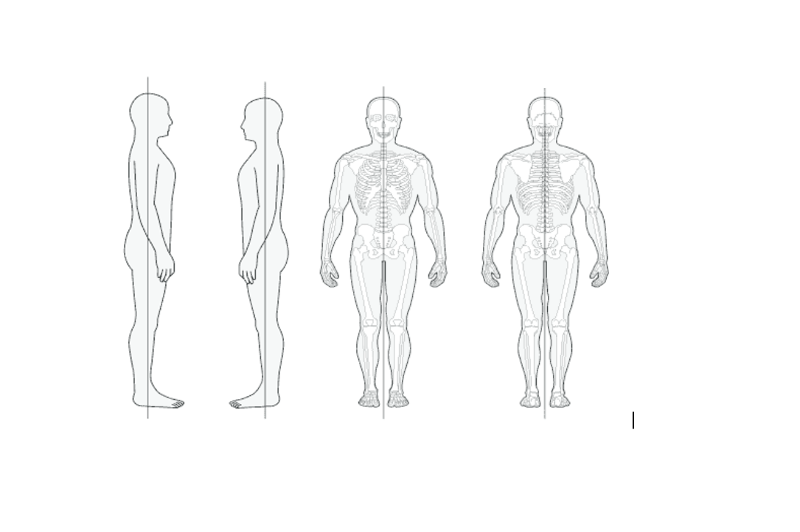
A postural assessment is an observational assessment used to analyse the posture and alignment of a client and it can help assess how their body is moving and functioning and then interpret any implications of this.
The aim is to look for any imbalances, deviations or muscle weaknesses for example, which may lead to discomfort and/or pain that could lead to dysfunction and/or injury.
It is important to note that everyone is different and variations of posture do not necessarily mean the client is experiencing discomfort or doesn’t fit the ‘perfect’ posture
Regardless of whether the client is experiencing pain or not, it’s still important to recognise and then deal with any and all problems highlighted.
Any abnormalities and imbalances that aren’t dealt with could cause pain, hold the client back from reaching their optimal performance, or potentially lead to an injury further down the line.
Who Can Carry Out A Postural Assessment?
Postural analysis tests can be carried out by trained ‘fitness’ professionals, including osteopaths, physiotherapists, sports massage therapists, pilates/yoga teachers, and personal trainers, however, this is only if they have the right training.
As mentioned above, the overall aim of a postural alignment assessment is to identify any issues or postural abnormalities, and then address them by introducing any necessary corrections, these corrections may include a specific programme of exercises, stretches, and lifestyle changes, or require some ‘hands-on’ manipulation, so it makes sense for a fitness professional to carry out this kind of assessment.
Sports Massage and Postural Assessments
At Active Health Group postural assessments were covered on both my Level 3 Sports Massage and my Level 5 Diploma in Clinical Sports Therapy and Rehabilitation.
Although clients may not be aware a good sports therapist is assessing clients as they walk into the treatment room, as they are standing discussing the treatment, removing their shoes and even getting on the couch, identifying postural abnormalities and getting an idea of potential techniques they need to incorporate into the treatment.
How someone stands. How someone walks, How someone bends, How someone squats. How someone takes off their coat. How someone gets onto the couch. All can give clues to any potential issues.
Normal vs Abnormal Posture
What exactly is normal? I’m not sure if normal vs abnormal is the heading I really want to use and wonder if optimal is a better description – an optimal posture that allows the body to move in its most efficient manner – versus a sub optimal posture which is not at the best possible level – bit of a mouthful but let’s go with it for now.
What we want to be looking for is:- the muscles on either side of the body are balanced, the pelvis is neutral, and the spine has a natural curvature to it (looking from the front or back) and laterally (from the side) there is an imaginary line that goes straight from the earlobe to the top of the shoulder, through the centre of the body, and then just behind the knee joint, ending in the middle of the ankle joint.
If the posture is ‘sub optimal’ or abnormal the client’s centre of gravity, body weight is shifted away from the centre line. Meaning muscles on one side of the body may have to work harder to compensate and keep the person’s posture stable.
Deviations can be caused by a range of different factors, including anatomical, occupational, social and cultural, and recreational factors.
I am not going to go through a whole postural assessment on this blog but I will do a follow up where I will get a couple of pictures of me and try and highlight areas where my posture could improve and what I could do to correct it.
As I said earlier in the article I do a quick overview when I meet the clients and tailor some of my techniques but perhaps it may be worth me offering a slightly longer treatment time that includes a thorough postural assessment that I share with the client ? What do you think?
Paul