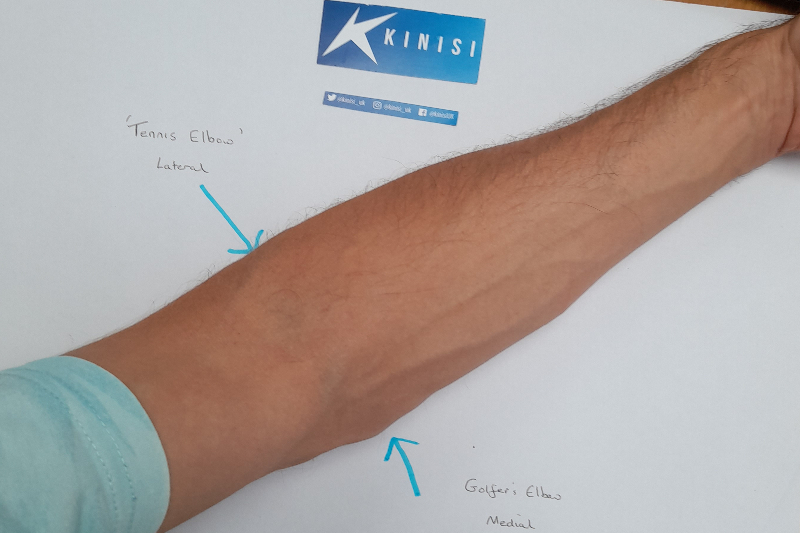
The elbow joint, like the knee joint, is what is referred to as a hinge joint; it connects the upper arm to the lower or forearm. There is not much we do during our day that doesn’t involve the elbow joint!
Bones
The elbow joint involves three main bones:
- Humerus: The upper arm bone (‘funny bone’ – not funny when we bang it!)
- Ulna: One of the forearm/ lower arm bones, located on the pinky side.
- Radius: The other forearm bone, located on the thumb side.
Joints
The elbow comprises three joints:
- Humeroulnar Joint: Where the humerus meets the ulna, enabling bending and straightening.
- Humeroradial Joint: Where the humerus meets the radius, contributing to the elbow’s range of motion.
- Proximal Radioulnar Joint: Where the radius and ulna meet near the elbow, allowing rotational movements of the forearm.
These joints are stabilised by ligaments and tendons, which control movements and provide stability. Injuries often stem from issues with these supporting structures.
Movements
The elbow allows several movements:
- Flexion and Extension: Bending and straightening the arm.
- Pronation and Supination: Rotating the forearm so the palm faces down (pronation) or up (supination). A handy tip: supination can be remembered as holding a bowl of soup.
Common Elbow Injuries
Tennis Elbow (Lateral Epicondylitis): Caused by repetitive motions, leading to inflammation of the tendons on the outside of the elbow. Common in activities involving repetitive wrist and arm motions.
Symptoms: Pain radiating from the outside of the elbow to the forearm and wrist, especially during activities.
Golfer’s Elbow (Medial Epicondylitis): Similar to tennis elbow but affects the tendons on the inside of the elbow. Often caused by repetitive wrist flexing and twisting motions.
Symptoms: Pain on the inside of the elbow, extending down the forearm. Pain may worsen with certain activities like lifting.
Elbow Bursitis: Inflammation of the bursa (a fluid-filled sac) over the elbow’s bony tip. Can result from trauma, prolonged pressure, or repetitive movements.
Symptoms: Swelling, pain, and redness at the tip of the elbow.
Ulnar Collateral Ligament (UCL) Injury: Common in athletes who perform overhead throwing motions. The UCL can be strained or torn due to repetitive stress.
Symptoms: Pain on the inner side of the elbow, especially during throwing motions. Possible instability in the elbow joint.
Fractures: Resulting from direct impacts or falls, fractures can involve any of the three elbow bones.
Symptoms: Severe pain, swelling, bruising, and an inability to move the elbow.
Preventative Measures
- Avoid repetitive motions and take regular breaks.
- Warm up properly before engaging in physical activities.
- Rest and recovery are crucial.
- Use supports like braces or kinesiology tape.
- Strengthening exercises for the muscles around the elbow.
- Proper techniques and posture during activities.
- Consider sports massage for maintaining muscle health and preventing injuries.
Final Thoughts
Your elbows are indispensable for countless daily activities. Keeping them healthy is essential for maintaining your overall well-being. If you ever experience elbow pain or discomfort, don’t hesitate to seek professional advice. As always, I’m here to help with any questions or concerns you might have.
Thanks for reading, and take care of those elbows!
Paul