You may be looking at this title and trying to decide what on earth is Paul talking about in this blog – actors, musicians, football (if you know, you know)!
However, what I want to cover is the various acronyms used when treating an acute injury.
Back in the late 1970’s, Dr Gabe Mirkin was credited with coming up with the mnemonic R.I.C.E – something I would like to think we have all heard of and possibly still use today as a go to when someone twists their ankle or bangs their head – but – is it the right treatment.
RICE – PRICE – POLICE
Let’s start by reminding ourselves what R.I.C.E means
R – Rest – after the ‘accident’ the patient must rest.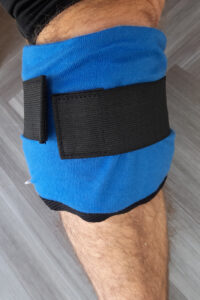
I – Ice – apply ice to the injury to reduce pain and swelling and control the inflammation.
C – Compression – apply a compress to the area which will again reduce the swelling and help support and protect the injury.
E – Elevation – this elevation uses gravity to return the blood to the heart which in turn reduces swelling which can be the cause of pain.
That all sounds pretty sensible to me !
However, with everything new evidence comes to light and as such Dr Mirkin took back his support for the RICE theory in 2014 after further understanding of the role of inflammation.
But I will expand on this shortly after introducing two more acronyms which are built on the RICE protocol – PRICE and POLICE.
PRICE – the addition of the P – Protection – makes sense, we don’t want more damage to occur before the healing process has had a chance to start.
POLICE – along with the Protection element we now have OL – Optimal Loading – this is replacing Rest.
It was understood that although rest seems an obvious solution after an injury by getting some movement or ‘optimal loading’ back into the injury as early as possible it would help the healing process to be more efficient.
So we already have 3 principles which have developed over the past 30-40 years which seem to agree to some point that, other than rest or movement, we should be using ice, compression and elevation to help reduce swelling, pain and inflammation…..however, why does inflammation occur?
Injury and Inflammation
There are 5 signs of injury – pain, redness, heat, swelling and loss of movement (sounds familiar) – well, inflammation is our bodies natural defence mechanism – when something isn’t right, our immune system recognises this and starts the healing process.
So are those 5 signs of injury happening for a reason, should we be trying to stop any of them?
So taking ‘Rest’ – aggressive movement of an injury in the early stages isn’t recommended (can you imagine grabbing someone’s twisted ankle and moving it rigorously – I foresee further injury to the therapist), however, movement will encourage circulation and blood flow to the area. Do people take the instruction ‘rest’ too far – too much rest can lead to reduced muscle strength and flexibility!
Ice may be helpful in reducing the pain and the swelling but is it promoting healing – no evidence supports this. Is the ice slowing down circulation which is preventing essential cells and nutrients reaching the injured area?
Compression may have an effect on swelling but is it promoting healing or just a comfort blanket around the injury (a bad thing?).
Elevation may temporarily reduce swelling which in turn can reduce the pain but again no evidence has shown it helps with the healing process.
The addition of P.O.L
With the added Protection and the Optimal Loading we are removing the Rest concerns as we are making sure the injury doesn’t get any worse but we are also adding some movement into the equation. This way we are encouraging circulation and therefore encouraging the healing process.
This would also suggest that although ice may be frowned upon as its cooling effect will slow down the circulation, but the correct use of ice, compression and elevation can help with managing the pain – if we manage the pain then maybe the optimal loading is easier.
Not as simple as we first thought or are we over complicating matters?
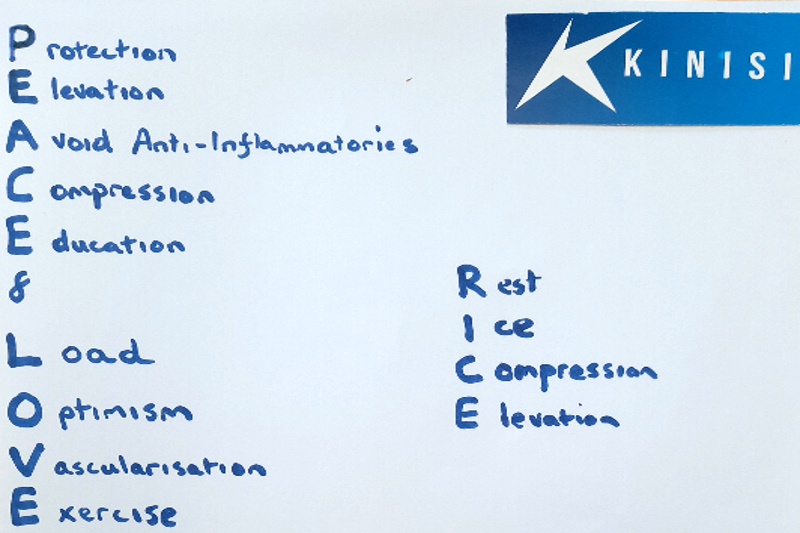
PEACE & LOVE
RICE, PRICE and POLICE historically have been used to focus on the injury immediately after it occurs, so as a first step to try and reduce the pain and limit the potential damage and manage the situation in the initial few days of an acute injury.
(More info on stages of healing – https://kinisiuk.com/the-3-stages-of-healing-or-is-it-4/)
In recent years a new acronym has come to the fore ‘PEACE & LOVE’ this is designed to be a two stage process – to manage the initial injury and to assist in the rehabilitation of the client.
P – Protection (Avoid things that cause pain in the initial days after injury)
E – Elevation (Elevate above the heart as often as possible)
A – Avoid anti-inflammatories (these can affect tissue healing and also avoid ice)
C – Compression (use tape or bandage to reduce swelling)
E – Education (your body knows best – let nature play its role)
&
L – Load (let pain guide you – your body will let you know when to increase the load)
O – Optimism (positive thinking)
V – Vascularisation (increase the blood flow using pain free activities)
E – Exercise (exercises to restore flexibility, strength and proprioception).
Now I am not going to go through all of the above points but you get the idea they are trying to make – our bodies are amazing and quite a lot of the time they will find a way and if we give them a helping hand then we can improve this healing process.
There are some things that make sense and some that are a little more difficult to grasp – i think the key to all these things are to find a way that suits you, as I state on quite a few of these blogs, everybody is unique – we are not a one size fits all and adaptations have to be made.
My personal opinion
Personally, I find that the initial use of ice benefits me greatly, I feel it reduces my initial pain and psychologically it helps and as long as I see professional sportsmen earning in an hour what I earn in a year with an ice pack on then it’s good enough for me! Then I’ll move on to getting the injury moving by introducing heat and exercise within my pain threshold.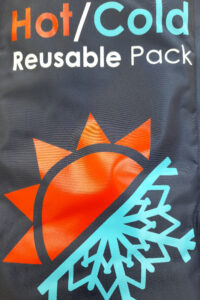
(Being married to a pharmacist, I will be honest, my judgment is swayed regarding anti-inflammatories – they are prescribed for a reason – however, I completely understand they aren’t for everyone and I must insist you make your own judgment on medication).
One thing that I don’t think is mentioned anywhere is PATIENCE – however desperate you are to get back out there just take your time to avoid setbacks – that race you have trained for isn’t worth another 12 months of injury – there are no shortcuts, your body will be ready when it is ready, you just need to give it every chance and if you ask for advice – listen and follow it.
So whether you are a RICE, POLICE or after a bit of PEACE & LOVE don’t forget to have a little Patience!
Hope this was of interest – thanks for reading, have a good day and see you soon.
Paul