Introduction
What is patellofemoral pain syndrome?
Patellofemoral pain syndrome is a condition where there is a dull pain around the front area of the knee, the patellofemoral joint which is behind the patella, or kneecap as it is more commonly known. It is in the area where the knee connects to the femur at the distal end. Patellofemoral pain syndrome is more commonly known as Runner’s Knee as it can be a common injury suffered by runners.
Anatomy of the knee
To understand a little more about the injury it is good to learn a little more about the anatomy and actions of the knee.
The knee is made up of two joints. The more commonly known tibiofemoral joint which is the joint between the femur (thigh bone) and the tibia (shin bone). The tibiofemoral joint is a uniaxial joint and is responsible for flexion and extension of the leg and minimal rotation.
The patellofemoral joint is a non-axial joint and has minimal movement, effectively the patella just slides over the femur.
The patella itself is a sesamoid bone (flat, floating bone), with a rounded downward pointing triangle shape, although the shape and size will differ with each and every client.

Diagram: Side view of knee joint.
The patella sits within the quadriceps tendon which is lined with cartilage and is the thickets in the whole body, it needs to be as it must withstand about 3 to 5 times the bodyweight of force when a person descends stairs. To help with the movement of the patella and the quadriceps tendon, there is a shallow groove at the front of the femur called the trochlear groove. As the knee flexes or straightens the patella sits in this groove and moves backwards and forwards allowing for smooth movement.
The other bone in this joint is the femur bone which is the largest bone in the human body and is classed as a long bone, it is more commonly known as the thigh bone and runs the length of the upper leg from the hip joint to the knee joint.

Diagram showing patella / trochlear groove
Also around the patellofemoral joint are several bursae, bursae are little fluid filled sacs which are designed to reduce friction, facilitate movement, and aid some shock absorption around a joint. In the instance we have the prepatellar bursa which is found just in front of the patella as well as the suprapatellar bursa (above) and the infrapatellar and subcutaneous bursa (below) the patella. To aid the bursas there are also small fat pads which help with the support and cushioning of the knee joint.
The tibiofemoral joint is much more complicated with the addition of numerous ligaments and also the menisci, however these are not normally associated directly with patellofemoral pain so will not be discussed at this point.
It is important to mention the muscles in the thigh at this point, tendons connect muscles to bone and the quadriceps are attached via the quadriceps tendon to the tibia and as mentioned above the patella sits within the quadriceps tendon so the associated muscles will have factor into the performance of the patellofemoral joint.
Specific anatomy/identification of patellofemoral pain syndrome
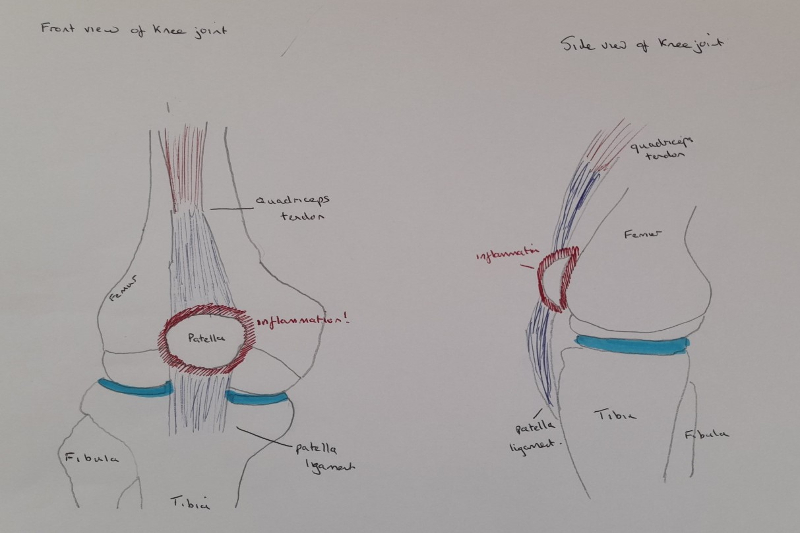
So, what exactly is patellofemoral pain syndrome and what are the causes and symptoms? Pain is felt in the soft tissues around the patellofemoral joint and occasionally inflammation or redness can be seen between the patella and the femur. There can also be a grinding or clicking sound when you flex or extend the knee joint, and the kneecap can be sore and tender to touch. The pain can be intensified if sitting with bent knees for a long time or by a sudden increase in intensity or duration of activity.

Diagram showing areas of inflammation in patellofemoral pain syndrome
Overuse is normally one of the main causes of the patellofemoral pain syndrome as it is the inflammation in the area caused by the continued use or overall degeneration of the soft tissue in the joint causing the pain and inflammation. It may also be a misalignment issue in the joint where the patella is slightly offline and does not track directly down the trochlear groove it is resting in, this then causes friction on the surrounding soft tissue and again leads to pain and inflammation in the joint. A direct trauma or blow to the area can also cause patellofemoral pain syndrome and needs to be considered when identifying the cause of the pain.
Assessment of Patellofemoral Pain Syndrome
Initial assessment of the injury will help try and identify the potential causes of the overuse or misalignment; however, a physical exam will be needed to try and identify the exact location of the pain with hands on treatment manipulating the area, feeling for tenderness, pain, swelling and any further damage to any of the surrounding bones and tissues.
If it is considered that it is indeed patellofemoral pain syndrome then some initial treatment may be needed before further consideration is taken into what is the underlying cause.
Treatments and Rehabilitation
There are a number of different techniques that we could use to treat Runner’ Knee and further rehabilitation can be done to help prevent a re-occurence.
However, everyone is individual and treatment plans would be bespoke per client.
Thanks for reading.
Paul